
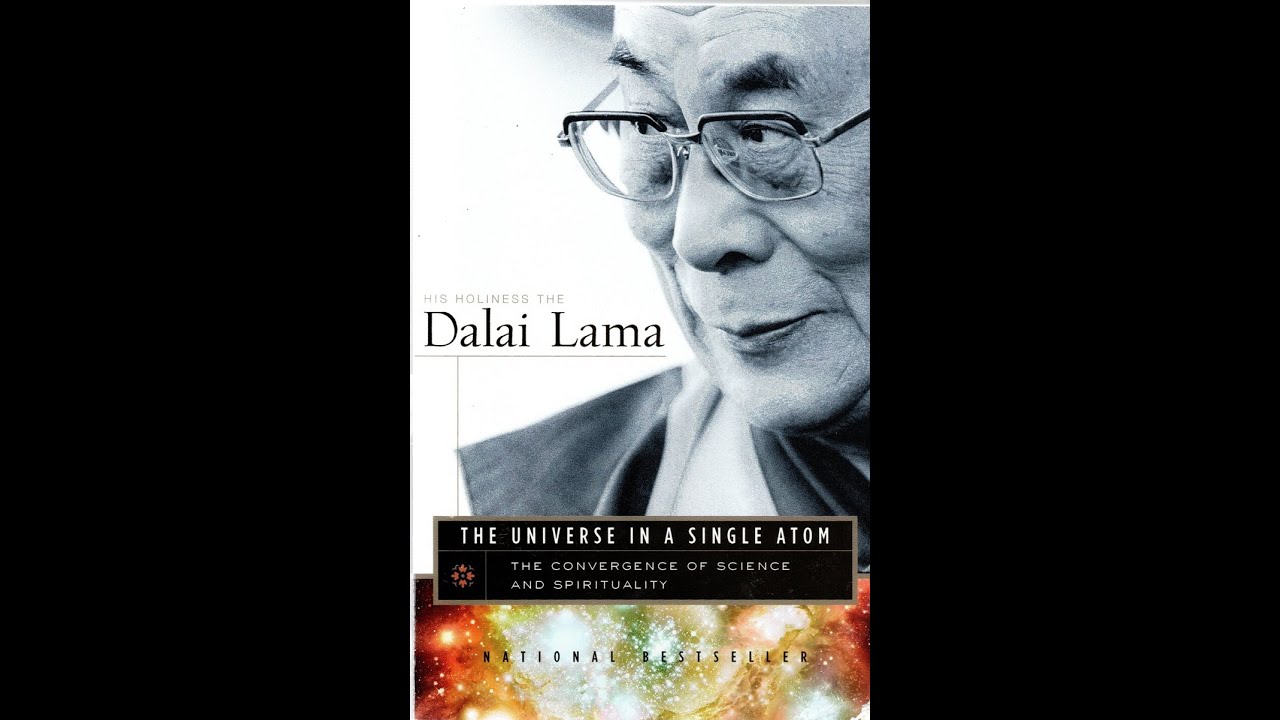
Dalai Lama and Science
Guests: Doug Sharp and Rich Geer
Description: This is a review of the Dalai Lama’s book “The Universe in a Single Atom.”
The beginning of his book deals with his life in isolation in Tibet, his exile, and encounters with scientists in the world.
“The Universe in a Single Atom” is self-contradictory. How can the universe be contained in a single atom if the atom is part of the universe?
The Dalai Lama admits that Buddhism must be willing to adapt the rudimentary physics of atomic theories despite longstanding authority and tradition. Early Buddhist theory of atoms proposes that matter is constituted by four elements: earth, air, water and fire. Then there are derivative substances: form, smell, taste and tactility. (Pg. 52-53). These foundational Buddhist ideas are in direct opposition to what we know to be true about the elements today.
Central to Buddhism is the theory of emptiness. (Pg, 66) (Pg 68).
Buddhism rejects essentialism: a belief that things have a set of characteristics which make them what they are, and that the task of science and philosophy is their discovery and expression; the doctrine that essence is prior to existence. This is contrary to absolute truth.
Tibet had complex myths of creation that originated in the pre-Buddhist religion of Bön. Shouldn’t a religion have an account that goes back to the very beginning? It brought order out of chaos, light out of darkness, existence out of nothingness. (Pg 76-77). Buddha really didn’t bother to explain origins. The Pali canon lists fourteen unanswered questions (Pg 78).
Early Buddhist Abhidharman cosmology invokes a flat earth around which celestial bodies revolve. (Pg. 79). Buddhist thought allows you to question the literal truth of any cosmology. There is a Kalachakra cosmology that allows for the evolution of celestial bodies within multiple universes. The Buddhist view asks the question if the big bang is the origin of everything or just our universe. They also reject an ultimate cause.
Luther Townsend’s book “The Bible and the Nineteenth Century” makes an important point in that pagan religions and philosophies espouse at their foundation blatant unscientific origin theories and cosmologies. The Bible writers were aware of these ideas but chose by divine revelation not to incorporate those errors into the Bible. This validates the Bible as the word of God. The Bible does not need to compromise with error, and that holds true with modern evolutionary cosmology.
