
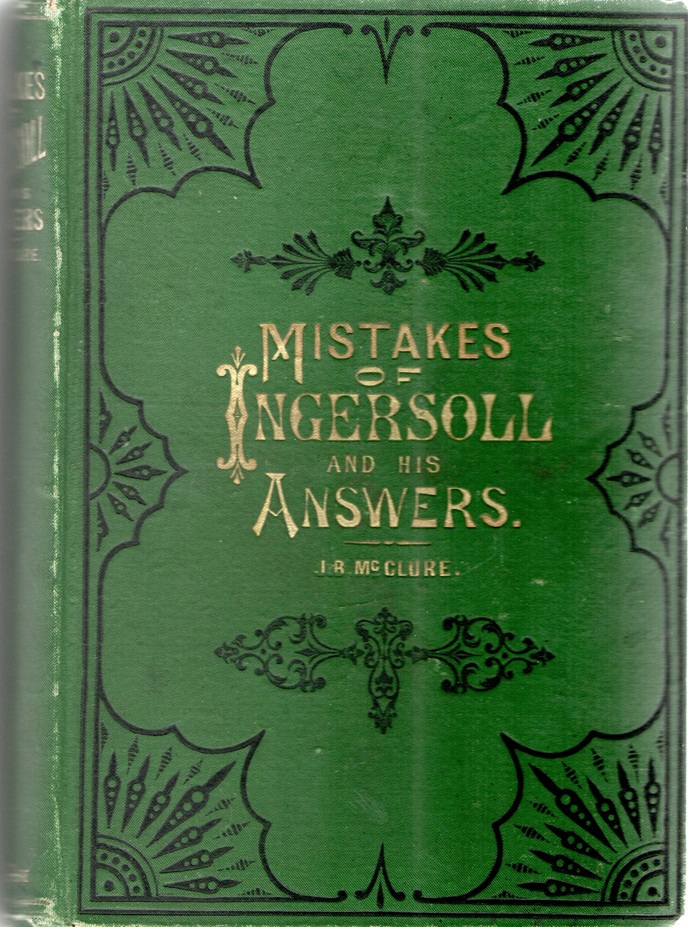
Mistakes of Robert Ingersoll
Guests: Doug Sharp and Rich Geer
Description: In freshman American Thought and Language class at MSU, a subtle deconstruction of the Christian faith was taught. They presented the sermon by Jonathan Edwards Sinners in the Hands of an Angry God as a typical sermon from the Puritans. They also talked about the Salem witch trials, the Calvinist doctrine of the elect, and finally a treatise by Robert Ingersoll, famous agnostic of the nineteenth century.
The nature of atheists or agnostics is that they defy natural logic that tells us our world is designed. The reasons may be that they may be mad at God, had a bad experience with church or Christianity, or just want an excuse to live a life free from the dictates of a straw man god they have painted for themselves.
I picked up a book called Mistakes of Robert Ingersoll at the Owl and Ivy antique store in Grand Ledge. It was written in 1879, and it was written in answer to Ingersoll’s lecture on the Mistakes of Moses. It was published by Rhodes and McClure in Chicago. The responses are by professors David Swing, Drs. Ryder, Heriford and Gibson along with Rabbi Wise.
Ingersoll’s lecture on Skulls is included at the end of the book, in response to these critics. Here is a summary of some of his arguments:
1. Those nearest to barbarism have a barbarian religion
2. Savages to civilization
3. Those who quit growing are orthodox
4. Row of human skulls (Neanderthal)
5.Those who believe in eternal punishment are barbarians
6. I love liberty and hate all persecutions in the name of God
7. Discrimination in the church against blacks
David Swing’s reply to Mistakes of Moses:
Moses was a leader who planned freedom for slaves; bore the complaining of his people, lived and died for the people, set up the 10 commandments, set up the fundamentals for a state that lasted 1,500 years, divested the idea of a god of bestiality, set up principles of wisdom, justice and tenderness, established industry, education and a higher form of religion. The Jewish religion produced Jesus Christ and the twelve Apostles. Jesus did more in His death than atheism could achieve in all its eons of geology.
Dr. Ryders reply:
Ingersoll is unfair in that he is knocking over a straw man. He attributes words to Moses that aren’t there. The heavens and the earth were not self-evolved but created by the Omnipotent Jehovah. Ingersoll unfairly points out that the Old Testament treated women with shame and humiliation. Not true. Ingersoll also argued against Noah’s flood, saying that you would have needed 800 feet of rain to cover the highest mountains, ignoring the breaking up of the fountains of the deep. Also, he disputed the Ark resting on 17,000-foot Mt. Ararat, where it could have rested on one of the other mountains of the region. He also treats a particular interpretation of the Bible and refutes it, then treats the whole Bible as being refuted. Ingersoll sets out to destroy religious faith but offers nothing in return.
Dr. Hereford’s reply:
Ingersoll has a paradox. The point of view in which he places the Bible is to make it an easier target for his wit. He repudiates any divine inspiration, yet he talks as if God is responsible for it. He represents heaven as a place where Christians will be happy to see the tortures of the damned. Nobody preaches that now.
He says that the Bible treats women unfairly. But there’s Naomi and Ruth, the Shunamite woman, Hannah and Proverbs 31. Also, Miriam. Ingersoll criticizes the Bible in its treatment of slavery, but it was universal in the ancient world and the way the Bible treats it, such as in Philemon, shows fairness in the indentured master/servant relationship, not like the cruel chattel slavery.
The Jewish Rabbi’s reply:
We need not pray for Robert Ingersoll’s soul, for he says he has none. He says that he could not imagine the existence of a God. That is an illogical expression. One of Ingersoll’s manufactured gods could be imagined in a disorderly imagination. What kind of God could be submitted to the imagination of a man without a soul?
Dr. Gibson’s reply:
The Bible isn’t intended to teach science. Huxley made merry over the word “whales” but the Hebrew word meant sea monsters such as the plesiosaurus and ichthyosaurus.
Gibson is disappointing here in that he argues that the bible doesn’t say anything about the age of the earth, and he invokes the day age theory and the gap theory to explain long ages of geology.
